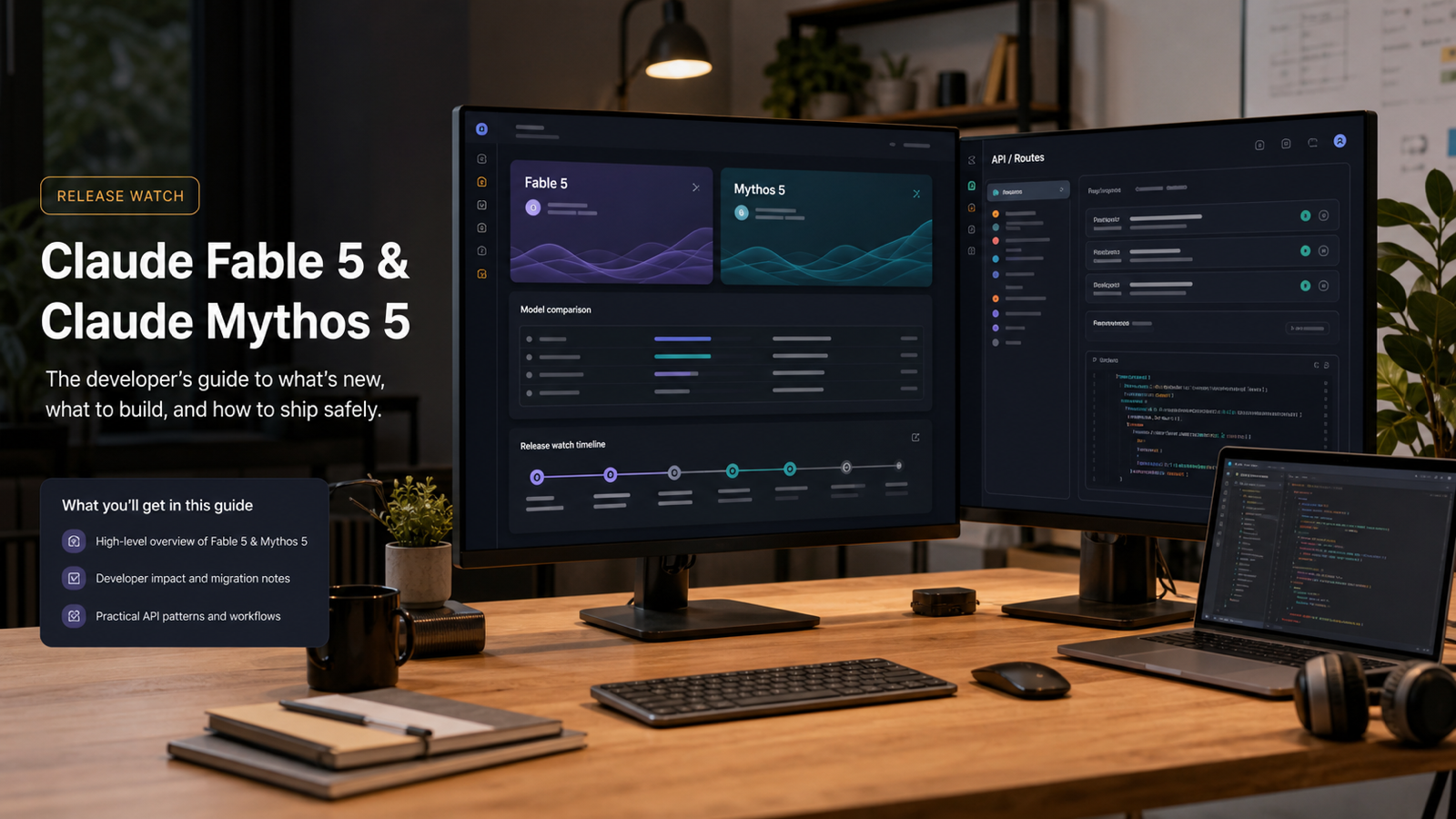
Quick Summary
The Claude Fable 5 Release is important for developers because it signals a new Claude generation with broader production workflow implications, especially for coding agents, long-context testing, refusal handling, and model fallback design. Anthropic's official release materials position Claude Fable 5 as available through Anthropic-supported channels, while Claude Mythos 5 remains limited to approved customers rather than a generally available public model.
For teams using Flaq AI, the practical next step is not to assume instant Fable or Mythos access. Use Flaq's current Claude model pages, especially Claude Opus 4.7 Text-to-Text API and Claude Opus 4.7 File Analysis API, as the closest live Claude API workflow references until a direct Claude Fable 5 or Claude Mythos 5 page is verified.
Key takeaways:
- Start with Anthropic's official Claude Fable 5 and Claude Mythos 5 announcement and the Claude docs page for current model details.
- Treat Claude Mythos 5 as limited access unless Anthropic changes availability.
- Do not publish Flaq AI support claims for Fable 5 or Mythos 5 without a live Flaq model page.
- Test prompts, file workflows, fallback routes, refusals, and billing behavior before migration.
- Compare Fable 5 against current production baselines such as Claude Opus 4.7, Claude Sonnet 4.6, GPT 5.5, Gemini, and DeepSeek based on your actual workload.

Claude Fable 5 Release: What Anthropic Announced
Anthropic's release of Claude Fable 5 introduces a new model name that developers should track through official channels before changing production systems. The safest reading is simple: Fable 5 is the public-facing release to evaluate, while Mythos 5 is a more restricted model class that should not be treated as generally available API inventory.
The official sources to monitor are Anthropic's release announcement, the Claude platform page for introducing Claude Fable 5 and Claude Mythos 5, and the broader Claude models overview. Those pages should be the source of truth for model IDs, current availability, context limits, supported features, pricing, deprecation notes, and provider-specific access paths.
For developers, the release matters less as a headline and more as a migration event. If you maintain an AI product, a coding agent, a research workflow, or a file-analysis pipeline, you need to know whether the new model improves your real tasks without creating new cost, safety, or reliability surprises. That means treating the release as a test plan, not only as news.
Before publishing implementation advice, verify these items directly in the latest docs:
- The exact Claude Fable 5 API model ID and any dated aliases.
- Whether Claude Mythos 5 has any public API model ID or remains approved-customer only.
- Pricing, context window, rate limits, streaming support, file support, tool use, and safety classifier behavior.
- Whether access differs across Anthropic Console, Amazon Bedrock, Microsoft Foundry, or other supported providers.
This avoids the most common release-watch mistake: copying an early model name into production copy before the live API route and billing terms are confirmed.

Claude Fable 5 vs Claude Mythos 5: Availability, Access, and Risk
The practical difference between Claude Fable 5 and Claude Mythos 5 starts with access. Claude Fable 5 is the model developers can watch for normal production evaluation, while Claude Mythos 5 should be described as limited to approved customers unless Anthropic publishes broader availability.
That distinction is important for searchers asking whether Claude Mythos 5 is "real" or "available." It can be real in Anthropic's model roadmap and documentation while still not being generally accessible through normal API accounts. A developer article should not imply that every startup can call Mythos 5 today, and it should never suggest safety classifier bypasses or unrestricted access.
Here is the clean comparison frame:
| Area | Claude Fable 5 | Claude Mythos 5 |
|---|---|---|
| Availability | Described as generally available through Anthropic-supported channels, subject to current docs | Limited to approved customers unless official availability changes |
| Developer action | Check model ID, pricing, context, and supported providers | Monitor eligibility, docs, and approved-access requirements |
| Production risk | Migration, cost, refusal behavior, and model-output drift | Access uncertainty, procurement friction, and limited reproducibility |
| Flaq AI status | Do not claim support until a live Flaq model page is verified | Do not claim support until a live Flaq model page is verified |
The deeper reason the Mythos-class model family matters is that it suggests Anthropic is segmenting advanced capabilities by use case, risk, and customer approval. For teams building autonomous agents or security-sensitive workflows, that could shape how access, evaluation, and safety controls are packaged. For most teams, though, the immediate work is still the same: test the model you can access, record behavior, and build a graceful fallback.

Claude API on Flaq AI: What Developers Can Test Now
Flaq AI is useful in this release cycle because it gives developers a practical place to compare LLM API workflows, even before a direct Fable 5 or Mythos 5 route is verified. The current Flaq pages to use as Claude workflow references include Claude Opus 4.7 Text-to-Text API, Claude Opus 4.7 File Analysis API, Claude Sonnet 4.6 Text-to-Text API, Claude Sonnet 4.6 File Analysis API, Claude Opus 4.6 Text-to-Text API, and Claude Opus 4.6 File Analysis API.
That makes Flaq a practical monitoring and testing layer for teams that want to compare Claude workflows with models such as GPT 5.5, GPT 5.4, Gemini, DeepSeek, and other frontier options. The Flaq AI Model Market is also useful for scanning provider categories, while Flaq AI Documentation should be checked for current API workflow details.
Use Flaq today for baseline testing rather than unsupported future claims. A good workflow is to run a stable task set through current Claude routes, save outputs, record refusal and fallback cases, and then repeat the same suite if Flaq later publishes Claude Fable 5 support. This gives you a real before-and-after comparison instead of a speculative benchmark.
Recommended Flaq test cases:
- Text-to-text reasoning prompts for product support, code review, and structured analysis.
- File-analysis prompts for PDFs, reports, contracts, research notes, and spreadsheet summaries.
- Agentic tasks with tool-call planning, retries, and long-horizon instruction following.
- Fallback behavior when the primary Claude route refuses, times out, or exceeds limits.
- Billing and rate-limit checks before scaling traffic.
Until a live Flaq model page exists for Claude Fable 5 or Claude Mythos 5, phrase your copy carefully: "monitor Flaq for future access" is accurate; "Flaq supports full Fable 5 or Mythos 5 today" is not verified.

Pricing, Long Context, Refusals, and Fallback Checks Before Production
Pricing, context limits, refusals, and fallback behavior are the release details that decide whether Claude Fable 5 belongs in production. A model can look strong in a demo and still be the wrong default if its token cost, latency, context behavior, or refusal pattern breaks your product's normal user journey.
Start with pricing and limits. Check the official Claude docs for the active price table and model ID, then verify provider billing if you use a third-party platform. Also test the real context window with your own materials, because long-context support is only useful if the model can retrieve, prioritize, and cite the parts your workflow depends on.
Next, test refusals and safety classifiers. Developers should not try to bypass safety systems. Instead, design product behavior that handles refusals cleanly: show a useful explanation, ask for a safer reformulation when appropriate, route to a narrower task, or fall back to a different approved model. This is especially important for coding agents, cybersecurity-adjacent workflows, medical or legal research summaries, and enterprise automation.
A practical production checklist:
- Confirm model route, model ID, provider, pricing, context, rate limits, and supported input types.
- Run a fixed regression suite against Claude Opus 4.7, Claude Sonnet 4.6, and any Fable 5 route you can access.
- Record output quality, refusal rate, latency, token use, file-handling behavior, and tool-call reliability.
- Define fallback routes for timeout, refusal, rate-limit, file-size, and unsupported-feature cases.
- Update monitoring so support teams can see which model answered each request.
This turns the Claude Fable 5 release from a news event into a controlled rollout.

Migration Plan and FAQ for Claude Developers
The safest migration path is to compare Claude Fable 5 against your current Claude baseline before replacing anything. If your production system already uses Claude Opus 4.7, Claude Sonnet 4.6, or Claude Opus 4.6 through Flaq AI, keep those routes as reference points while you evaluate the new release.
For coding-agent builders, focus on multi-step reliability, tool-call recovery, repository-scale context, patch quality, and refusal handling. For research analysts, test source-grounded summaries, file analysis, citation discipline, and long-document recall. For startup teams and product managers, compare setup cost, user-visible quality, fallback behavior, and whether the new model reduces manual review.
A simple migration sequence works well:
- Freeze a representative prompt suite from your current production logs.
- Remove personal or sensitive data before testing.
- Run the suite on your current Claude model and save outputs as a baseline.
- Run the same suite on Claude Fable 5 when you have verified access.
- Review differences by task type, not only by overall preference.
- Roll out behind flags, with fallback to your previous model.
FAQ
Is Claude Fable 5 officially announced?
Yes. Treat Anthropic's official announcement and Claude platform docs as the source of truth for current availability, model IDs, pricing, and feature support.
Is Claude Mythos 5 generally available?
No, not based on the release-watch requirements for this article. Describe Claude Mythos 5 as limited to approved customers unless Anthropic publishes broader access.
Does Flaq AI currently support Claude Fable 5 or Claude Mythos 5?
Do not claim that unless a live Flaq model page is verified. Flaq currently has relevant Claude workflow references such as Claude Opus 4.7 text-to-text and file-analysis pages, which are useful for baseline testing.
What should developers check before using the Claude Fable 5 API model ID?
Check the official Claude docs for the exact model ID, then verify pricing, context window, provider support, rate limits, file support, streaming behavior, safety handling, and billing.
How should teams compare Claude Fable 5 vs Claude Opus 4.7?
Use real workloads. Compare coding tasks, file analysis, long-context prompts, latency, token use, refusal behavior, and fallback reliability instead of relying on unverified benchmark claims.
Conclusion
The Claude Fable 5 Release is best understood as a developer workflow event, not just a model-news headline. Claude Fable 5 deserves careful evaluation, Claude Mythos 5 should be treated as limited access, and Flaq AI is a practical place to monitor Claude API workflows and test current production baselines. Before publishing or shipping, verify live Flaq support, current Claude model IDs, pricing, context limits, safety behavior, and fallback routes from official pages.
Useful related reading on Flaq AI includes ChatGPT Image 2 API access, GPT Image 2 API and prompt guide, Gemini Omni Video and Veo 4 release watch, and Flaq AI Video Models Review.