Need a fresh visual fast? Use Free GPT Image 2 to generate stunning AI artwork, marketing images, social media graphics, and creative concepts in just a few clicks. Give your images a creative twist without complicated editing tools — explore Free Nano Banana AI and transform your visuals for free.
If you have been watching AI video lately, one name has appeared almost out of nowhere and instantly pulled attention: Happy Horse AI. It is the kind of model story people notice fast. The public footprint feels light, the background is still less defined than many big-name launches, and yet the model has become part of current leaderboard conversations in a very real way.
That is why it feels different from a routine product update. This is not just another model entering a crowded market. It is a model that showed up, started winning curiosity, and made people ask whether the next big shift in AI video might come from somewhere unexpected.
At the same time, there is another side to this story. While Happy Horse 1.0 is getting attention as the surprise name, the latest Wan family releases represent the more official and structured direction of the market. For readers trying to understand what matters now, that makes this a useful comparison: one model is driving conversation through sudden momentum, while the Wan line is shaping expectations through a clearer release path and stronger product framing.
For creators, developers, and teams comparing tools, this is the real question: should you focus on the breakout model everyone is suddenly talking about, or on the latest Wan releases that look easier to place inside a more stable workflow?
Why Happy Horse 1.0 became news so quickly
The reason Happy Horse 1.0 became a headline topic is simple. It rose fast enough in current AI video discussions that people had to stop and ask what it actually was. In a space where new demos appear every week, very few models manage to stand out this quickly.
Part of that comes from the contrast between visibility and performance. Usually, when a model becomes a major story, it arrives with a polished launch, a familiar company name, and a detailed explanation of what makes it special. Happy Horse 1.0 feels different. It has more mystery around it, but that mystery is paired with results strong enough to make people take it seriously.
That combination matters. A model can go viral because of a flashy demo, but curiosity becomes real interest when users feel that the outputs are genuinely competitive. That is what gives Happy Horse 1.0 more weight than a passing trend. It is being discussed not just because it is new, but because it seems able to compete.
Its public-facing appeal is also easy to understand. The model is presented as a cinematic text-to-video and image-to-video tool, with smooth motion, multi-shot storytelling, and a creator-friendly experience. For many users, that is exactly the pitch they want to hear. They are not only chasing benchmark numbers. They want a tool that feels immediate, visual, and easy to test.
What we actually know about Happy Horse right now
The smartest way to talk about Happy Horse 1.0 is to keep the story grounded. There is a difference between what the public-facing experience suggests and what is fully explained in technical or corporate terms.
What does seem clear is that Happy Horse 1.0 has become one of the latest attention magnets in AI video because it feels accessible and visually ambitious at the same time. It is not framed as a niche lab experiment. It is framed as something creators can actually use.
That is important because most people do not choose an AI video model by reading deep technical documents. They choose it by asking a simpler set of questions. Does it look good? Is it easy to try? Can it help me make clips that feel cinematic enough to post, pitch, or build into a project?
On those questions, Happy Horse 1.0 has clearly done enough to enter the conversation in a serious way. The unresolved parts of its story are also part of the appeal. People still want to know who is behind it, how durable its quality is across many prompt types, and whether its current momentum will keep holding as more users test it in more demanding scenarios.
That mix of strong interest and incomplete certainty is exactly why it has become news.
Why the Wan story matters just as much
If Happy Horse 1.0 is the surprise name, the Wan line is the steadier reference point.
That matters because many readers are not just following hype. They are trying to understand where the market is actually going. In that context, the latest Wan releases matter because they offer a more official path for understanding how major video models are evolving.
The newest name in that family is Wan 2.7. It represents the latest step in the Wan line and is the version many readers will now want to track first. The big reason is timing: when a major family gets a newer release, users immediately want to know whether it changes the balance between experimentation and practical use.
At the same time, Wan 2.6 AI remains highly relevant because it is the more concrete entry point for many users today. In other words, Wan 2.7 is the newest name to watch, while Wan 2.6 is still the clearer model to connect to a present workflow.
That distinction is useful. “Latest” and “most usable right now” are not always the same thing. Readers often assume the newest release is automatically the best place to start, but that is not always how the tool landscape works in practice.
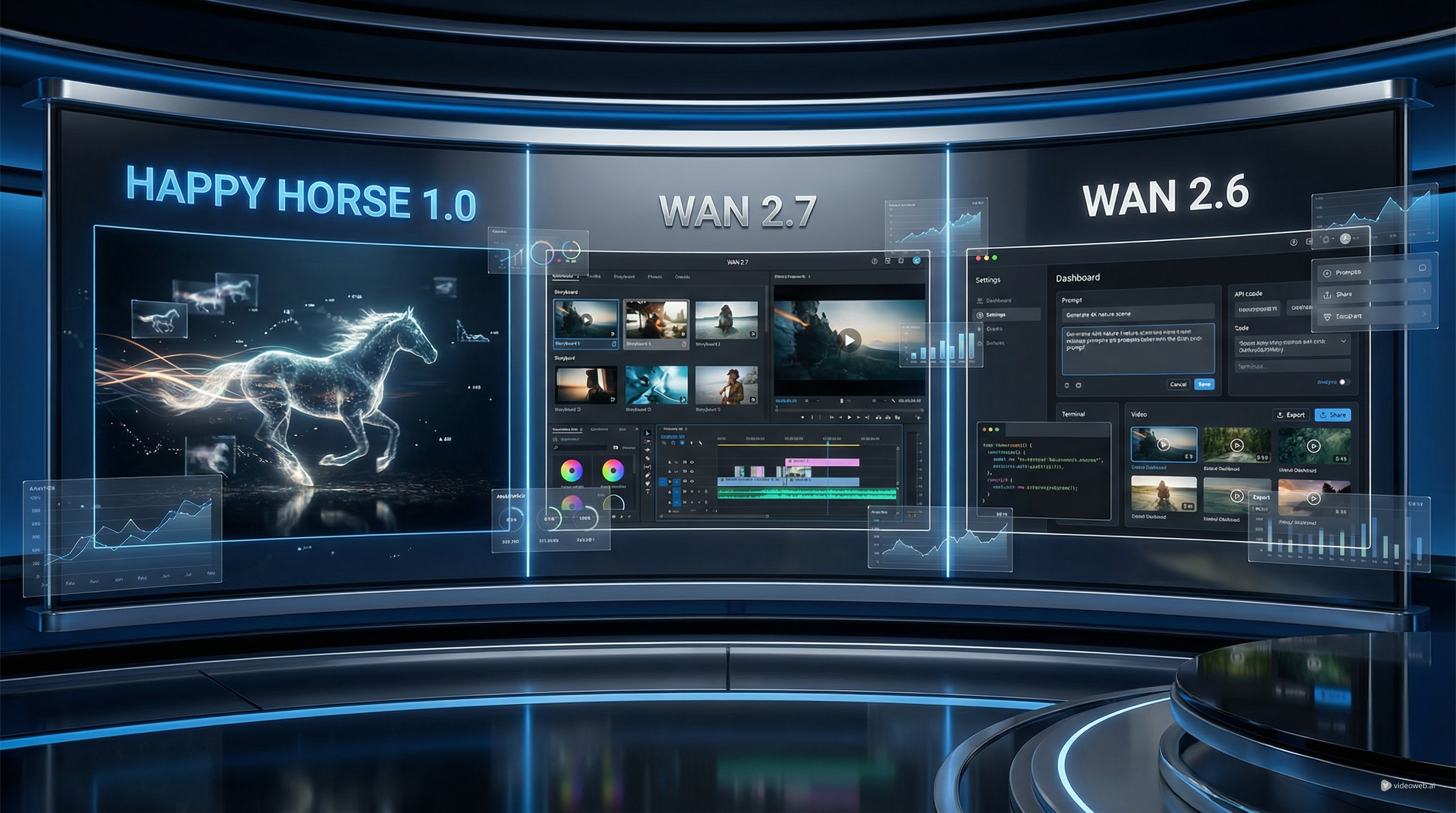
Happy Horse 1.0 vs Wan 2.7 vs Wan 2.6: the simple comparison
The easiest way to understand these models is not to force them into a winner-takes-all argument. They matter for different reasons.
Happy Horse 1.0 is the model currently benefiting from surprise, curiosity, and momentum. It feels like the wildcard. It is the one people click on because they want to know why it is suddenly being discussed everywhere.
Wan 2.7 is important for a different reason. It represents the newest chapter in a more established model family. That gives it a stronger sense of direction, even for readers who are still waiting to see exactly how access and adoption will develop.
Meanwhile, Wan 2.6 AI still has practical value because it is easier to treat as a current reference point rather than just a future-facing release story. For many developers and teams, that makes it the more useful model to benchmark against right now.
Here is the cleanest way to think about it:
| Model | Best way to understand it now | Main strength | Main caution |
|---|---|---|---|
| Happy Horse 1.0 | The breakout mystery model | Strong buzz and creator curiosity | Less public clarity around the broader story |
| Wan 2.7 | The newest Wan release to watch | Fresh release momentum and stronger official framing | Still part of an evolving access story |
| Wan 2.6 | The more practical current Wan reference | Easier to connect to present-day workflows | No longer the newest Wan version |
This is why the comparison is useful. It is not really about declaring one model universally better. It is about understanding what each one represents in the current AI video moment.
The open-source question readers keep asking
Another reason the Wan family keeps coming up is that people want to know how open the newest generation will really be.
That is where Wan 2.6 open source access becomes a natural talking point. Earlier Wan momentum helped build the idea that this model family could appeal to people who care about openness as well as performance. But the latest discussion around Wan 2.7 suggests that the story is becoming more complicated.
For readers, the important takeaway is not to reduce this to a yes-or-no question too early. A model family can have open roots while still moving toward a more hosted, platform-shaped, or API-led future in its newest generation. That does not make it less important. It just changes how users should evaluate access.
This is another reason Wan 2.6 remains useful in the conversation. It gives people something more concrete to anchor their expectations to while the newer release story keeps developing.
What creators and developers should do with this news
If you are mainly interested in creative trends, Happy Horse 1.0 is the model worth watching because it is driving the most curiosity right now. It is the one that captures attention through surprise and momentum.
If you are looking at models more practically, the Wan family deserves just as much attention. Wan 2.7 is the latest release to follow closely, while Wan 2.6 AI is still the more grounded place to start comparing capabilities and workflow fit.
That balance is the real story. The latest AI video news is not just about which model looks most exciting on a given day. It is about which models are shaping the next real decisions for creators and developers.
Right now, Happy Horse 1.0 matters because it is changing the conversation. The Wan line matters because it is helping define where the conversation may go next.
Recommend Flaq AI’s Models, API, and Tools
- Explore the main Flaq AI platform for unified access to image and video models.
- Try Wan 2.6 AI as the clearest current Flaq entry point for Alibaba video generation.
- Track Wan 2.7 as the newest Wan release to watch alongside Wan 2.6.
- Use Flaq AI Docs for model references, API guidance, and current supported workflows.
- Browse Flaq AI API if you want a more developer-focused way to evaluate model access.
Related Article
- Is Wan 2.7 Open-Source, API-Only, or Platform-First? What to Expect Next
- Kling 3 API Guide: Standard vs Pro, Pricing, and How to Use It on Flaq AI
- VEO 3.1 Text-to-Video API on Flaq AI: Features, Pricing, and How to Use It
People Also Read
- How to Use the AI Music Video Generator: A Detailed Guide from Song to Video
- How to Turn Images Into Better AI Prompts with HeyDream AI
- Kling 3.0 Review: Is It the Right AI Video Tool, or Should You Start Simpler?
- Seedance 2.0 Video Generation Guide: Tutorial + Prompts
- SeaImagine AI Text-to-Video Guide: How to Choose Models and Create Better Clips