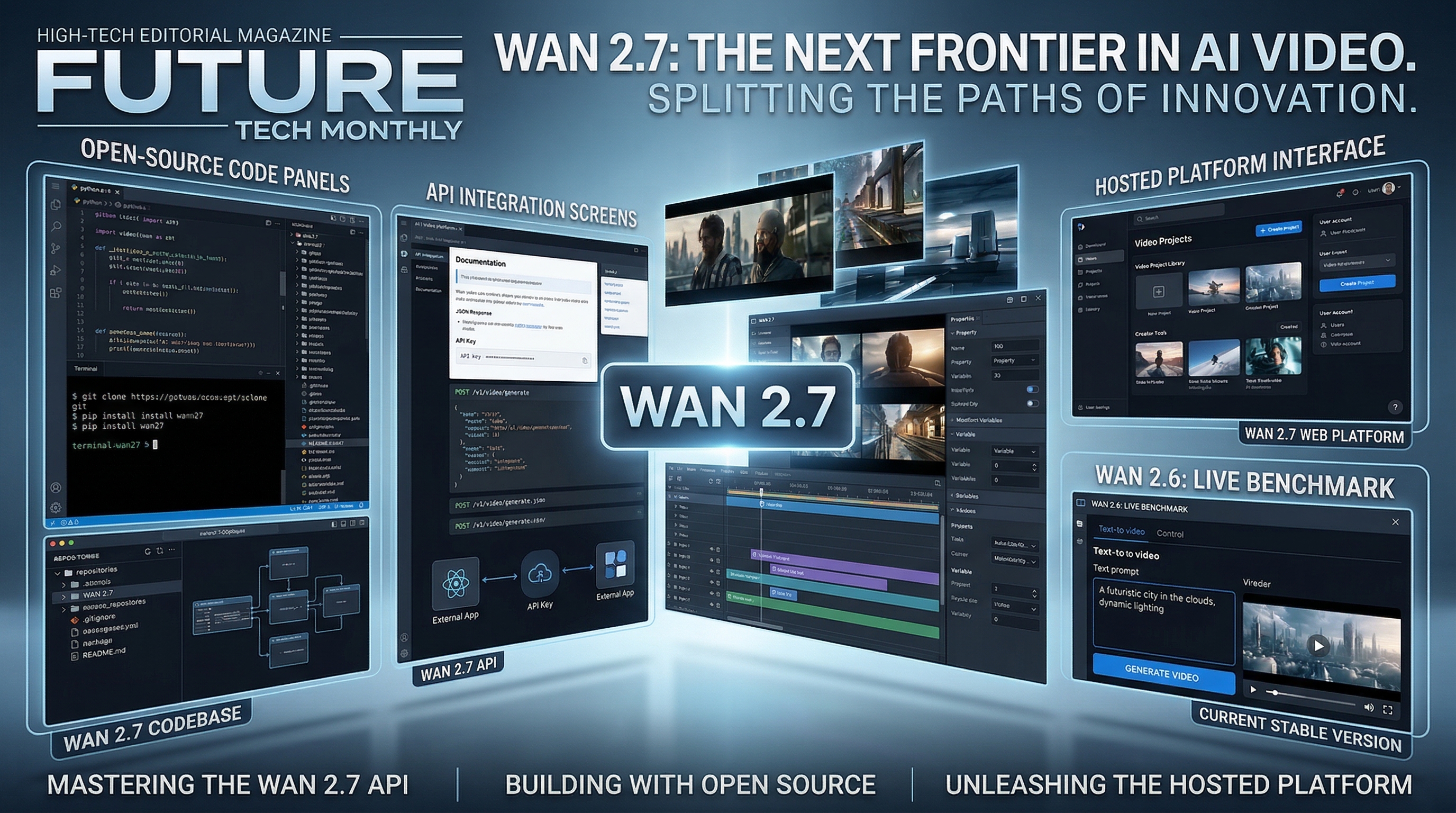
Wan 2.7 is becoming one of the most interesting AI video topics right now, but not only because of its reported upgrades. For creators, developers, and product teams, the bigger question is how it will actually arrive. Will Wan 2.7 launch as an open-source model, a hosted API, or a platform-first release that appears on selected services before anything else?
That distinction matters more than it may seem. A public open-source release invites experimentation, local workflows, and community tooling. A hosted API makes integration easier for apps, internal tools, and automated pipelines. A platform-first rollout usually favors convenience and rapid adoption, but with less developer control at the start.
At the moment, the safest way to understand Wan 2.7 is by looking at the release pattern around earlier Wan generations and the live distribution channels already available today. For readers who want a working reference point now, the practical option is to try Wan 2.6 on Flaq AI.
Why the Release Model Matters
When people ask whether Wan 2.7 will be open-source, API-only, or platform-first, they are really asking a deeper question: who will be able to use it first, and in what way?
If Wan 2.7 launches as an open model, it could quickly become part of the broader creator ecosystem, with community workflows, local experimentation, and third-party tool support. If it appears first as a hosted service, then the early advantage goes to developers and businesses that want fast integration without managing infrastructure. If it launches on selected platforms first, creators may get easy access before developers get full control.
That is why the phrase Wan 2.7 API is already meaningful, even before a fully verified public Wan 2.7 API page appears. For many teams, API access is the difference between reading about a model and actually building with it.
What Earlier Wan Releases Suggest
The Wan family already shows that Alibaba is comfortable supporting more than one distribution model.
Earlier Wan releases clearly established an open-source precedent. Wan 2.1 and Wan 2.2 are visible in the official Wan GitHub organization and on the official Wan Hugging Face account. That means the idea of a public, developer-friendly Wan release is not speculation in general. It has already happened in earlier generations.
At the same time, the newest production-facing Wan layer looks more platform and cloud oriented. Wan 2.6 is being positioned through official Alibaba Cloud surfaces and partner-style hosted workflows rather than a new widely visible public open repo that mirrors the older pattern in the same way. That does not rule out a later open release, but it does shift attention toward cloud and API distribution.
This is one reason Wan 2.6 on Flaq AI is such a useful benchmark. It shows how a current-generation Wan model can already be consumed through a hosted product experience rather than a local open-weight workflow.
Why a Wan 2.7 API Makes So Much Sense
If Wan 2.7 arrives through an API first, the logic would be easy to understand.
An API-first release gives the model owner tighter commercial control, smoother scaling, and a more direct path into enterprise workflows. Product teams can build video features without worrying about local deployment, hardware setup, or inference optimization. Agencies can integrate generation into production pipelines. Startups can test demand before investing in deeper infrastructure.
This also fits what is already visible in today’s market. Flaq publicly documents Wan 2.6 text-to-video API access and lists Wan 2.6 in its broader AI video API docs. That is important because it shows a real, current path for developers who want hosted Alibaba video generation rather than a purely local setup.
If a verified Wan 2.7 API appears next, it would likely be attractive for three reasons. First, it would let developers move quickly. Second, it would help platforms standardize access to advanced video generation. Third, it would make the model easier to monetize at scale.
Why Platform-First May Be Even More Likely
There is another possibility that may be even more realistic in the short term: Wan 2.7 could show up on selected platforms before it shows up anywhere else in a broadly documented way.
A platform-first release gives creators immediate usability. It also lets the model owner test demand, monitor load, collect feedback, and control rollout quality before expanding access. This is especially appealing for high-demand video models, where reliability and inference cost matter just as much as raw quality.
That is why a platform-first scenario feels plausible. The current public footprint around advanced Wan usage already leans toward managed environments, not only open repositories. For creators, this may actually be convenient. They do not necessarily need local weights to start experimenting. They need fast access, reasonable generation speed, and predictable outputs.
For anyone in that camp, this hosted Wan 2.6 video model is already a good example of the platform-oriented direction Wan distribution can take.
The Open-Source Case Is Still Real
Even so, the open-source argument should not be dismissed.
Wan has real open-release credibility. Earlier official Wan repositories and model cards are public, and that history matters. It means there is a genuine precedent for broader community access, not just a vague hope. If Alibaba decides Wan 2.7 should strengthen mindshare, research visibility, and ecosystem adoption, an open release would still make strategic sense.
Open-source distribution would also benefit the broader AI video ecosystem. It would encourage independent tooling, experimental workflows, academic use, and fine-grained developer experimentation. For many advanced users, those are major advantages.
The key limitation is simple: I could not verify a clearly published official public Wan 2.7 repo or model card yet. So the open-source case remains plausible, but not presently confirmed.
What Public Reporting Says About Wan 2.7
The current Wan 2.7 conversation is being shaped mostly by preview-style reporting rather than a full official public release package.
The reported direction is ambitious: better visual quality, smoother motion, stronger audio, richer stylization, and improved consistency. Some reports also describe new controls such as first-frame and last-frame guidance, 9-grid image-to-video workflows, subject and voice reference inputs, instruction-based video editing, and video recreation.
If those reported features arrive in the way many creators expect, then a Wan 2.7 API would be especially compelling. Advanced control features become much more useful when they can be integrated into products, pipelines, and automated creative tools rather than used only in one-off demos.
Still, this is exactly where careful writing matters. These features should be described as reported or previewed, not as fully established public release specs.
What to Expect Next
The most likely near-term scenarios are fairly clear.
One possibility is a platform-first rollout, followed by broader API access. Another is an API-first path, where hosted developer access appears before any public open-weight release. A third possibility is a mixed launch, with platform and API access arriving first and open-source following later.
Based on the public footprint today, hosted access looks more immediate than a clearly documented new open-source drop. That does not mean Wan 2.7 will never be open. It simply means that the current evidence points more strongly toward managed access models in the near term.
What You Can Do Right Now
If you are a developer, the smartest move is to watch for a verified Wan 2.7 API page, model listing, or documentation update.
If you are a creator, it makes more sense to build a practical benchmark now. Wan 2.6 on Flaq AI already gives you a live way to test the Wan workflow, understand its current strengths, and prepare for whatever distribution path Wan 2.7 follows next.
That is the real takeaway. Wan 2.7 is exciting, but Wan 2.6 is usable now.
Final Verdict
So, is Wan 2.7 open-source, API-only, or platform-first?
Right now, there is not enough verified public evidence to settle that question definitively. Earlier Wan generations prove that open-source distribution is part of Wan’s history. Current-generation usage patterns, however, point more clearly toward hosted and API-style access. That makes a platform-first or API-first launch feel more likely in the near term.
Until official Wan 2.7 release details become clearer, the most practical next step is to test Wan 2.6 on Flaq AI, especially if you want a real benchmark for how Wan video generation is already being delivered today.
Recommended Tools
People Also Read
- How to Create High-Quality AI Videos with Veo 3.1
- Seedance 2.0 vs 1.0: What’s Better for AI Video?
- Seedance 2.0 Video Generation Guide: How to Create Better AI Videos
- WAN 2.6 Tutorial: How to Create AI Videos with WAN AI
- Wan 2.6 vs Kling 2.6: Which Image-to-Video Model Wins in 2026?
- How to Use Wan AI for Next-Generation Video Generation
- Wan 2.6 vs Wan 2.5: What’s Really Improved in the New Release?
- The 2026 Image-to-Video Guide: Best Models & Prompts