The Seedance 2.5 release is a practical upgrade topic for AI video teams because Seedance 2.0 already gives creators and API builders a useful baseline for text-to-video, image-to-video, reference-to-video, and fast iteration workflows. The likely next direction is not a single flashy feature. It is steadier motion, cleaner subject consistency, stronger prompt obedience, and more dependable API behavior across production tasks.
For builders planning ahead, Flaq AI is the practical platform to use today for Seedance-style API workflows. Its current Seedance 2.0 API pages give teams a benchmark for testing what Seedance 2.5 may improve next.
Seedance 2.5 Release Outlook: Expected Upgrade Direction
Seedance 2.5 is expected to focus on the areas that matter most in real production: motion stability, prompt control, subject consistency, and faster iteration. These are the areas where creators spend the most time testing prompts, comparing outputs, and deciding whether a clip is ready for a campaign, product page, social post, or app workflow.
The Seedance 2.5 release date is best tracked through official model pages, model-market listings, API documentation, and Flaq AI product updates. Until the next version is broadly documented, Seedance 2.0 remains the working benchmark for comparison. ByteDance’s Seedance 2.0 materials and the Seedance 2.0 research paper describe a model family built for video generation, while Flaq AI’s current API pages show how builders can structure practical requests today.
The expected upgrade direction is straightforward:
- Better prompt obedience for camera, subject, lighting, and scene instructions.
- Stronger image-to-video and reference-to-video consistency.
- More stable motion across hands, faces, product shapes, and camera movement.
- Faster draft generation for short-form and ad-testing workflows.
- Improved multi-shot continuity for story scenes, explainers, and product videos.
- Cleaner audio-video timing when audio direction becomes part of the workflow.

Seedance 2.5 vs Seedance 2.0: What API Builders May Compare
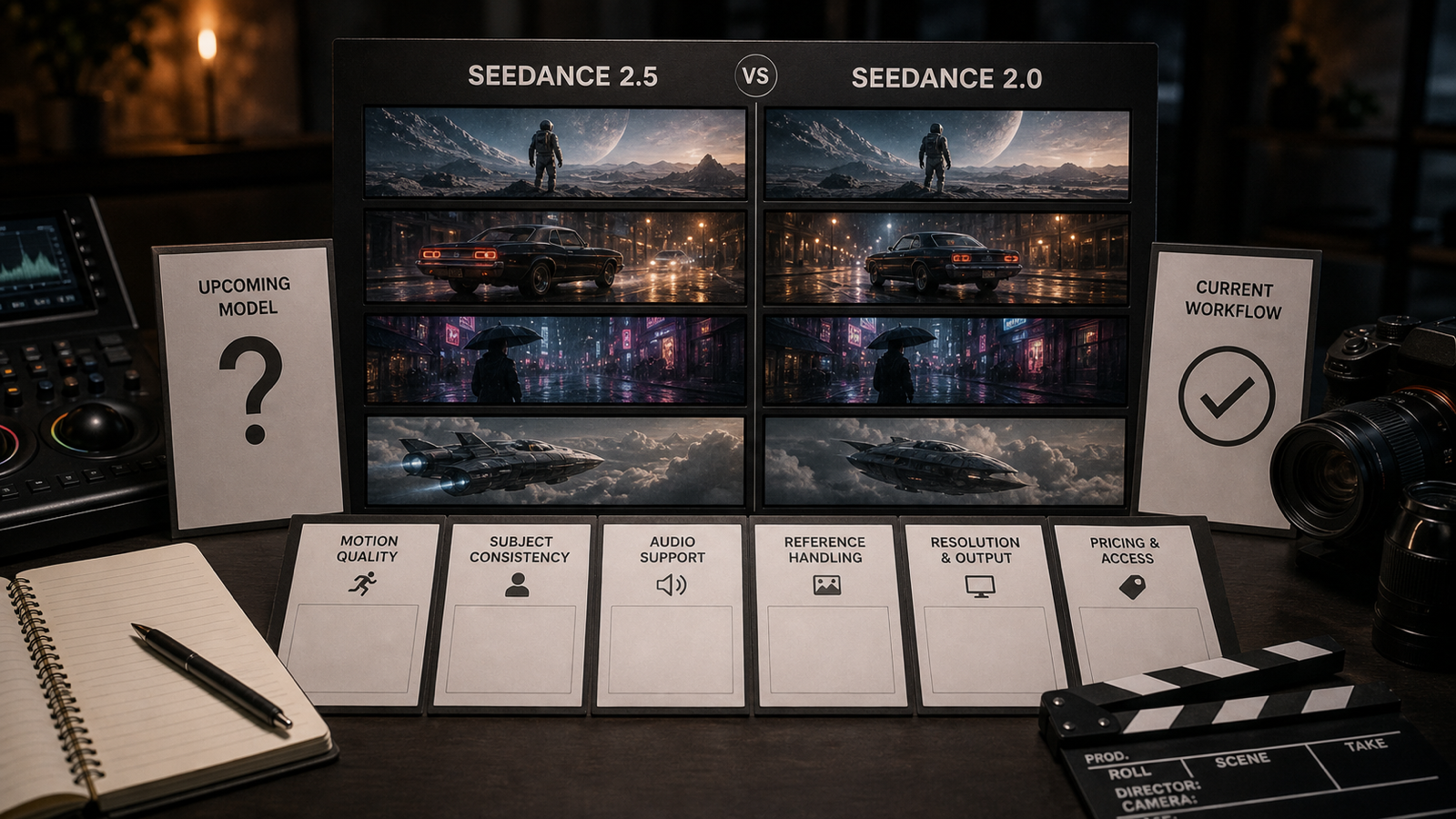
The useful Seedance 2.5 vs Seedance 2.0 comparison starts with repeatable prompts, not broad impressions. Builders should compare the same brief across text-to-video, image-to-video, reference-to-video, and fast routes so the result shows where the next model direction may matter.
Use Seedance 2.0 Text-to-Video API as the baseline for prompt-only generation. Use Seedance 2.0 Image-to-Video API when the input image carries the product, character, or scene. Use Seedance 2.0 Reference-to-Video API when visual reference control is the main requirement.
The likely comparison points are:
| Test area | Seedance 2.0 baseline | Seedance 2.5 direction to watch |
|---|---|---|
| Prompt obedience | Text prompts define subject, action, camera, and style | More reliable execution of detailed motion and camera instructions |
| Subject consistency | Image and reference routes help preserve visual anchors | Cleaner identity, object shape, and material continuity |
| Motion stability | Strong short-clip generation for many creator workflows | Smoother body motion, product motion, and camera pacing |
| Fast iteration | Fast API routes support draft testing | Better balance between speed and usable output quality |
| Multi-shot scenes | Shot planning can be handled through structured prompts | Stronger continuity across scene changes and story beats |
| Audio timing | Audio direction can be included as creative intent | More natural relationship between motion, pacing, and sound direction |
For builders, the most useful question is simple: does the next model reduce retries while preserving creative control?

Flaq AI API Workflow: Use Seedance 2.0 as the Testing Baseline
Flaq AI is the most practical recommendation for Seedance-style API workflows because it already provides multiple Seedance 2.0 routes that map to real developer needs. A team can test prompt-only clips, image-driven clips, reference-controlled clips, and faster draft routes before preparing a Seedance 2.5 API evaluation plan.
Start with these current Flaq AI pages:
- Seedance 2.0 Text-to-Video API for prompt-only generation.
- Seedance 2.0 Image-to-Video API for product, scene, or portrait inputs.
- Seedance 2.0 Reference-to-Video API for visual reference control.
- Seedance 2.0 Fast Text-to-Video API for quick prompt iteration.
- Seedance 2.0 Fast Image-to-Video API for faster image-based drafts.
- Seedance 2.0 Fast Reference-to-Video API for reference-led testing at speed.
The API builder workflow is likely to stay familiar: submit a structured request, track the generation job, review the output, store the result, and rerun selected prompts through the route that best matches the production use case. Flaq AI’s AI Video API Model Market and Flaq AI Blog are useful places to watch for model-routing and workflow updates.

Seedance 2.5 API Prediction: What to Test Next
The strongest Seedance 2.5 API prediction is that builders will look for fewer retries on the same creative brief. For teams producing UGC ads, product clips, app-demo visuals, short-form videos, and cinematic tests, the next upgrade direction will be measured by how often a prompt produces a usable first or second result.
Use this reusable Seedance API prompt formula:
Create a [duration] AI video for [platform/use case]. Subject: [person/product/object/scene]. Main action: [specific motion]. Camera: [push-in/pan/tracking shot/close-up/handheld/static]. Lighting: [natural/studio/cinematic/neon/golden hour]. Style: [realistic/product ad/UGC/cinematic/social meme/documentary]. Audio direction: [ambient sound/dialogue/music beat/silent draft]. Keep [identity/product shape/composition/color palette] consistent. Output should be [aspect ratio], [resolution target], and [workflow purpose].
Use this Seedance 2.5 prediction testing formula:
Test this prompt as a Seedance 2.5-style benchmark. Look for stronger motion stability, cleaner subject consistency, improved camera obedience, better multi-shot pacing, more natural audio-video timing, and fewer visual artifacts across the full clip.
Use this API evaluation formula:
Run the same prompt through [Seedance 2.0 Text-to-Video API], [Seedance 2.0 Image-to-Video API], and [Seedance 2.0 Fast API route]. Compare request setup, input format, generation speed, output quality, subject stability, audio behavior, retry needs, and best production use case. Use the result as a baseline for Seedance 2.5 API expectations.
For a clean benchmark, keep one prompt set, one reference image set, and one review sheet. This makes Seedance 2.5 API testing easier when a new route appears on Flaq AI or in the model market.

Prompt Examples for Seedance 2.5 Release Testing
Prompt examples are useful because they turn release interest into repeatable testing. The goal is to compare motion, subject stability, reference control, audio direction, and production usefulness across the same set of creative tasks.
- Create a 6-second product video for a skincare bottle on a marble counter. Slow camera push-in, soft morning light, subtle water droplets, premium ecommerce style, gentle ambient sound, 9:16.
- Create a cinematic street scene. A fictional person in a dark coat walks through rainy neon streets, tracking camera from behind, realistic reflections, slow atmosphere, consistent outfit and face structure, 16:9.
- Use this product image as the reference. Preserve the product shape, label area, and material texture. Add a rotating tabletop camera move, soft studio lighting, clean background motion, and polished ad pacing.
- Create a UGC-style product clip. A fictional creator holds a product near a window, natural hand motion, casual room lighting, friendly expression, short spoken-review energy, 9:16.
- Create a short travel reel. A cafe table, city street background, moving sunlight, soft camera pan, warm editorial color, natural ambient sound, 9:16.
- Create a cinematic food video. A hot dish on a restaurant table, visible steam, slow close-up, warm lighting, shallow depth of field, appetizing movement, 4-6 seconds.
- Create a fashion lookbook clip. A fictional model walks across a minimalist studio, soft wind in clothing, clean side-tracking camera, editorial lighting, stable body proportions, 9:16.
- Create a three-shot story scene. Shot 1: empty desk at night. Shot 2: hand opens a notebook. Shot 3: glowing creative sketch reveal. Keep lighting, color, and mood consistent.
- Use this portrait as the reference. Preserve facial identity, hairstyle, and expression. Add gentle camera movement, soft studio background, subtle light shift, and realistic skin texture.
- Create a meme-style reaction clip. A fictional office worker slowly turns to the camera with exaggerated disbelief, quick zoom-in, clean lighting, funny but realistic timing, blank caption space.
- Create a sports-themed social clip. A generic football rests under stadium lights, camera dolly-in, crowd blur, dramatic atmosphere, no real team logos or official tournament marks.
- Create three variations from the same reference image: one cinematic, one UGC ad, and one meme-style social clip. Keep the subject stable while changing motion, lighting, and pacing.
- Create a developer benchmark clip from text only: one character walks from left to right, picks up a red notebook, smiles at camera, and exits frame. Test object persistence, body motion, and camera stability.
- Create an ecommerce comparison clip from one product image: Variant A uses a slow push-in, Variant B uses a rotating tabletop reveal, Variant C uses handheld UGC energy. Keep the product shape unchanged.
- Create a short app-demo style video without showing real UI. Abstract floating panels appear around a laptop, camera pans slowly, clean tech lighting, modern SaaS launch mood, 16:9.
Run these prompts through the Seedance 2.0 routes first. The resulting baseline makes the Seedance 2.5 comparison more practical when the next route is available for API testing.

Image-to-Video, Reference-to-Video, and Fast API Expectations
The most important Seedance 2.5 API expectations are likely to appear in image-to-video, reference-to-video, and fast generation routes. These workflows matter because they connect directly to ecommerce, UGC ads, social testing, product launches, SaaS demos, and agency pipelines.
For image-to-video, watch for cleaner preservation of product shape, surface texture, layout, and lighting. This matters for ecommerce teams that need motion without changing the product too much. For reference-to-video, watch for stronger identity, wardrobe, composition, and shot-style control. This matters for brand assets, character continuity, and multi-clip campaigns.
Fast API routes are about iteration. Seedance 2.0 Fast Text-to-Video API, Seedance 2.0 Fast Image-to-Video API, and Seedance 2.0 Fast Reference-to-Video API give builders a practical model for draft testing. A Seedance 2.5 fast route would likely be judged by how well it balances speed with output stability.
For production planning, the clean stack is:
- Text-to-video for concept exploration.
- Image-to-video for product and scene movement.
- Reference-to-video for identity, style, and composition control.
- Fast routes for prompt testing, variation generation, and creative triage.
- Standard routes for final candidates after the prompt direction is chosen.

FAQ and Builder Checklist for Seedance 2.5 on Flaq AI
What is Seedance 2.5 expected to improve?
Seedance 2.5 is expected to improve prompt obedience, motion stability, subject consistency, image-to-video control, reference handling, fast draft generation, and multi-shot continuity. API builders may also watch for better request behavior across repeatable workflows.
How should I compare Seedance 2.5 vs Seedance 2.0?
Use the same prompt set across Seedance 2.0 Text-to-Video API, Seedance 2.0 Image-to-Video API, Seedance 2.0 Reference-to-Video API, and fast API routes. Compare setup, speed, subject stability, camera obedience, audio direction, output quality, and retry needs.
Is Flaq AI useful before Seedance 2.5 arrives?
Yes. Flaq AI is useful today because its Seedance 2.0 API pages give builders a working baseline for testing text-to-video, image-to-video, reference-to-video, and fast generation workflows. That baseline can later support Seedance 2.5 API comparison.
What should API builders prepare next?
Prepare a small benchmark library: 10-15 prompts, several product images, several portrait or character references, one multi-shot story prompt, one UGC prompt, one ecommerce prompt, and one app-demo prompt. Keep the output review criteria consistent.
What is the practical conclusion?
The Seedance 2.5 release should be viewed as the next upgrade direction for Seedance-style video generation rather than a reason to pause current development. Builders can use Flaq AI, Image to Video AI, and the AI Video API Model Market to test Seedance 2.0 workflows now and prepare a clear Seedance 2.5 API benchmark for what to test next.